 Temple Museum ➚


History
Beopjusa during the Goryeo Dynasty
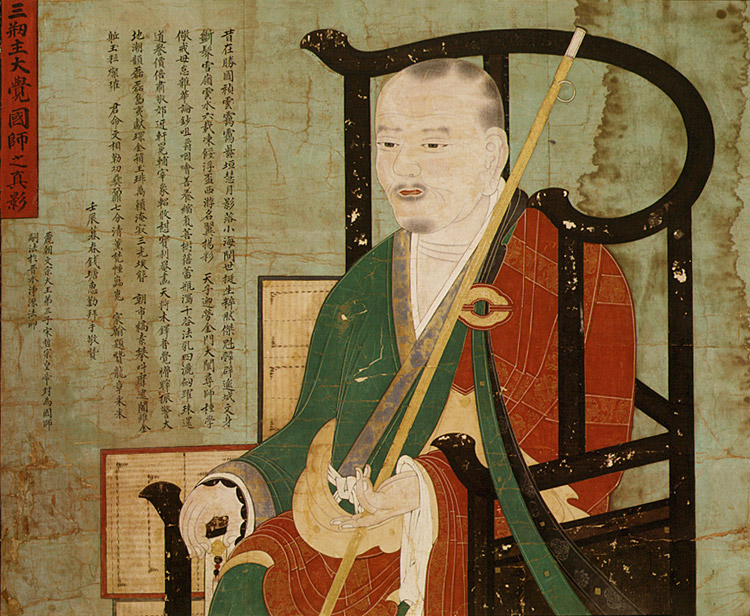

Entering the Goryeo Dynasty, many preeminent priests resided at Beopjusa and on several occasions reconstruction took place. First of all, Dosaeng-Seungtong, who was the 6th son of King Munjong (1046~1083) served as the abbot of the temple. Daegak National Preceptor Euicheon, the 4th son of King Munjong, and Hyedeok Royal Teacher Sohyeon, the 5th son of King Munjong, are the elder brothers of the Venerable Dosaeng.
Buddhism was the state religion of Goryeo Dynasty, which was an object of absolute belief for the king and the people. The royal family thought of it as a great honor if a prince became a monk. Especially, King Munjong was so devout that he let three sons become monks.
Not many records remain as to the activities of the Venerable Dosaeng, but he became a monk under the Royal Teacher Haedeok, who was a genuine monk of the Dharma-character School, and his teacher said that he also belonged to the Dharma-character School. In addition, the fact that the Venerable Dosaeng served as the abbot of Beopjusa shows that the temple inherited the tradition of the Dharma-character School which had continued from the Shilla Dynasty. The histories of temples during Goryeo Dynasty are recorded in the 'Commentary on the Penitence Meeting held in Songni Temple' compiled by Kim Bu-sik during the reign of King Injong (1122~1146), 'Epitaph in Beopjusa, Mt.
Songni, Goryeo' written in 1342 (3rd year in the reign of King Chunghye), and 'Epitaph of Dosaeng Seungtong'. Through this, we can see that until the reign of King Injong, the temple was called Songni Temple, the same as the name of the mountain, and it must have been held in high regard as Kim Bu-sik, a famous confucian scholar, wrote the commentary on the penitence meeting held in the temple on the orders of the king. During the reign of King Wonjong (1259∼1274), the High Priest Jajeong Misu (1240∼1327), a famous monk of the Dharma-character School during the Mid-Goryeo period, resided at the temple.
Having become a monk at the age of 13, he practiced at Beopjusa, Jangeuisa, Guklyeongsa, and Daemincheonsa temples. When he stayed in Beopjusa, he wrote 92 various kinds of scriptures and commentaries by the order of the king. In 1281 (the 7th year of the reign of King Chunglyeol) the king visited the temple and paid homage at the Sanhojeon building, and King Chungsuk followed suit. In 1363 (the 12th year of the reign of King Gongmin) the king dropped by the temple and sent a messenger to Tongdosa Temple in Yangsan to ordered 1 piece of the Sarira (sacred relics) of Buddha to be moved and enshrined in Beopjusa. The Sarira pagoda still remains behind Neunginjeon building.