 Temple Museum ➚


Hermitage
Hermitages within the Beopjusa precinct on Mt. Songnisan
| Hermitage | Sujeongam 수정암 |
|---|---|
| Head Monk | Seokjun |
| Phone | 043-543-3713 |
| Address | (28908) 379 Beopjusa-ro, Songnisan-myeon, Boeun-gun, Chungbuk |
Sujeongam (水晶庵) sits beneath Sujeongbong Peak, across from the One-Pillar Gate at the entrance to Beopjusa. In 1914 the bhikkhuni Venerable Taesu (泰守) built the Samseonggak shrine and a meditation hall, which was rebuilt in 1960. In 1973 the Geungnakjeon hall, the Jinyeonggak portrait hall and the monks’ quarters were added. At the entrance stand Venerable Taesu’s stupa and stele and a merit stele for Bang In-hyeok. It is a place of practice for bhikkhunis (nuns).
| Hermitage | Dongam 동암 |
|---|---|
| Head Monk | Wonjang |
| Phone | 043-543-3550 |
| Address | (28908) 405-46 Beopjusa-ro, Songnisan-myeon, Boeun-gun, Chungbuk |
Dongam (東庵) lies across the stream from the Chongji Zen Center. It was destroyed during the Imjin War. In 1977 Venerable Seongdo (聖道) vowed to restore it, and through the offerings of the lay Buddhist Jeongo (正悟) Han Gap-jin (韓甲振) a Dharma hall, the Gwaneumjeon hall, living quarters and a stone pagoda were built and dedicated in 1980.
Behind the Gwaneumjeon is a small rock cave, and on the hill behind grow some forty Korean stewartia trees, about sixty years old — a species native only to the Korean Peninsula.
| Hermitage | Talgoram 탈골암 |
|---|---|
| Head Monk | Hyeun |
| Phone | 043-543-4780 |
| Address | (28908) 569-72 Beopjusa-ro, Songnisan-myeon, Boeun-gun, Chungbuk |
Talgoram (脫骨庵) takes its name from a legend of the Silla King Talhae’s reign: Alji (閼智) of the Gyeongju Kim clan, born with a mouth like a rooster’s beak, came here, drank the spring water and prayed, and his face became that of an ordinary person — hence “the hermitage where the bones were shed.” Great Master Byeogam (碧巖) rebuilt it in 1624, and it burned down during the Korean War. Part of it was rebuilt in 1954. From 1967 the bhikkhuni Venerable Yeongsu (榮修) lived here, building the Samseonggak in 1977 and completing a meditation hall in 1990, named Daehyu Seonwon (大休禪院). The Yaksajeon hall and the Unhadang and Yeonhwadang living quarters were completed in 1995. There is a three-story stone pagoda, and near the entrance below the old Dharma hall site grows a Korean jujube-leaf tree (manggae-namu) designated a Natural Monument. The hermitage sits beneath Hyangnobong Peak.
| Hermitage | Bokcheonam 복천암 |
|---|---|
| Head Monk | Yongdam |
| Phone | 043-543-4774 |
| Address | (28908) 702-5 Beopjusa-ro, Songnisan-myeon, Boeun-gun, Chungbuk |
Bokcheonam (福泉庵) was founded in 720 (the 19th year of King Seongdeok of Silla). King Gongmin of Goryeo (r. 1351–1374) wrote the name plaque “Muryangsu (無量壽)” for its Geungnakjeon hall in his own hand. In 1464 King Sejo of Joseon prayed here for three days with Venerables Sinmi (信眉), Hakjo (學祖) and Hakyeol (學悅); after bathing at the bathing spot his skin disease was cured, and he had the temple repaired and bestowed a square jade tablet inscribed “Mannyeon Boryeok (萬年寶曆).” It burned in 1592 but was soon rebuilt. Its buildings include the Geungnakjeon, Nahanjeon, Sansingak, a meditation hall and living quarters. Two stupas remain: that of Venerable Suam Sinmi (1480) and of Venerable Hakjo Deunggok (1514). In a crevice of the great cliff to the right of the hermitage is the Bokcheon (福泉, “Spring of Blessings”) spring. Seon Master Wolseong (月性) resided here for more than thirty years, running the Bokcheon Seonwon (福泉禪院). Bokcheonam is said to be the navel of Songnisan.
| Hermitage | Jungsajaam 중사자암 |
|---|---|
| Head Monk | Jiryun |
| Phone | 043-542-5093 |
| Address | (28908) 832 Beopjusa-ro, Songnisan-myeon, Boeun-gun, Chungbuk |
Jungsajaam (中獅子庵) lies below the ridge of Munjangdae. It was maintained as a memorial shrine to pray for King Wonjong (元宗大王), father of King Injo, the 16th king of Joseon. In 1641, at the request of Injo’s brother Grand Prince Neungwon, Venerable Jiseon (智禪) rebuilt it, and fields at Yonghwa were donated to the temple.
It was repaired in 1757 by the palace official Yi Su-chang and the abbot Venerable Hyeonik, again in 1837 by the chief monk Venerable Haun, and extensively once more in 1887.
Its present form dates from 1985, when Venerable Jonghyeon rebuilt the temple, and the Samseonggak was newly built in 1986; today Venerable Jiryun (智輪) practices here. On the slope to the left is the site of the Bangsan cave hermitage, and below it a rock shaped like a king’s hat, called Gwanmoam (冠帽岩, “Tanggeon Rock”), where people hoping to pass state examinations or win office have long come to pray. In front of the hermitage is a large boulder carved with the character 佛 (Buddha), topped by a repair stele. On the right-hand ridge stands a stupa, the Haeam Seoneun Stupa (海菴禪隱之塔). Bohyeonbong, Chotdaebong and Hyangnobong peaks can be seen beautifully from here.
| Hermitage | Sanggoam 상고암 |
|---|---|
| Head Monk | Bojeok |
| Phone | 043-543-4995 |
| Address | (28908) 658-24 Beopjusa-ro, Songnisan-myeon, Boeun-gun, Chungbuk |
Sanggoam (上庫庵) sits beneath Birobong Peak. When Beopjusa was founded, three storehouses were built to gather building materials, called the upper, middle and lower stores (Sanggo, Junggo, Hago). It was rebuilt in 1876 by Great Master Inmyeong (仁明) and repaired in 1897 by Great Master Bobong (普峰). After falling into ruin it was rebuilt in 1963: the Yeongsanjeon hall in 1966, the Geungnakjeon in 1975, and the Sansingak, an octagonal nine-story pagoda and a stone lantern in 1976. A merit stele for its restoration was erected in 1978, and the Yaksajeon hall and living quarters in 2001. A rock bears the carved words “Palgongdeoksu” (water of eight virtues), and the Four Heavenly Kings are carved on a rock in the precinct. 200 m to the south a Thousand Buddha Hall sits inside a rock cave, and 300 m to the west stands a thousand-year-old pine. Halfway up the path is the site of Junggoam, and on a rock below it is a shape like a monkey’s face. Going around to the left from Sanggoam is the Sanggo Stone Gate, topped by a great “squid rock,” and below it lie Cheongnyanggul Cave (淸凉窟) and the site of Yeongcheonam. The cave is deep enough that a light is needed to enter.
| Hermitage | Sanghwanam 상환암 |
|---|---|
| Head Monk | Wongyeong |
| Phone | 043-544-3690 |
| Address | (28908) 658-22 Beopjusa-ro, Songnisan-myeon, Boeun-gun, Chungbuk |
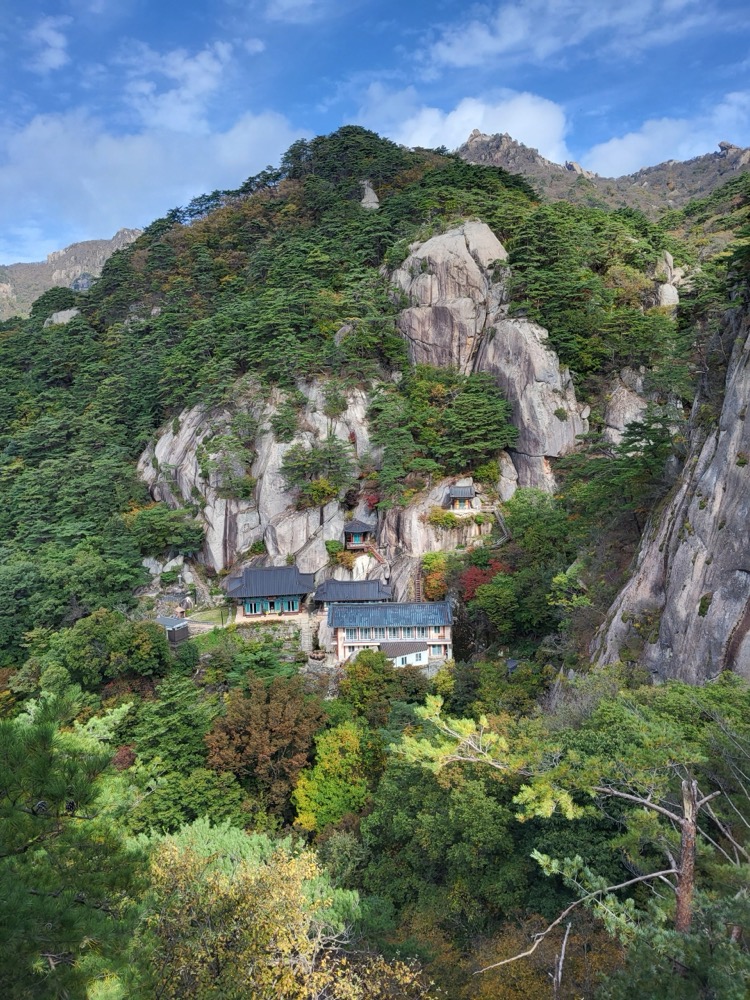
Sanghwanam (上歡庵) was named “the hermitage of the king’s joy” because Yi Seong-gye (李成桂) offered a hundred-day prayer here and, rejoicing, ascended the throne as King Taejo of Joseon. It was completely destroyed in the war of 1950. In November 1960 Seon Master Beobun (法雲), then residing at Beopjusa, vowed to rebuild it and undertook a thousand-day prayer, and the Wontongbojeon hall and Samseonggak were built in 1963. To the left of the Wontongbojeon stands a restoration stele erected in 1977. At the entrance is Eunseon Falls; the cliff opposite is called Haksodae, and on the slope in front of it is the “Aegi-gochu” rock, long visited by women praying for a son.
| Hermitage | Gwaneumam 관음암 |
|---|---|
| Head Monk | Hyewol |
| Phone | 043-543-5128 |
| Address | (28908) 658-191 Beopjusa-ro, Songnisan-myeon, Boeun-gun, Chungbuk |
Gwaneumam (觀音庵) was founded in 663 (the 3rd year of King Munmu of Silla) by Great Master Hoewol (晦月) at the age of sixty; he entered nirvana here at 108. In 1955 Venerable Seonam came to reside and carried out the building work seen today. On the rock face behind the hermitage is carved “Gyeongeopdae (慶業臺),” the place where General Im Gyeong-eop (1594–1646) trained for seven years in military strategy and martial arts under Great Master Unyeo Dokbo; originally the words “Cheonmyeongdae (天命臺)” were carved there. The Diamond Stone Gate at the entrance bears the words “Avalokiteshvara Bodhisattva” and “Sesimmun (洗心門, Gate of Mind-Cleansing).” At the entrance stand a stone pagoda and the stupa and stele of Venerable Seonam. Born in Yeongwol, Gangwon-do in 1898, he was ordained at Haeinsa under Venerable Kim Seogu and from 1937 practiced at the Jikjisa meditation hall in Gimcheon and elsewhere. After settling here in 1955 he spent thirty-seven years in retreat, reciting the Diamond Sutra and the Sutra on the Deep Kindness of Parents until he passed away in 1991, aged 94, in his 65th year as a monk.
| Hermitage | Yeojeogam 여적암 |
|---|---|
| Head Monk | Hyeonseong |
| Phone | 043-543-5920 |
| Address | (28908) 407 Sanae 1-gil, Songnisan-myeon, Boeun-gun, Chungbuk |
Yeojeogam (汝寂庵) is named after Venerable Yeojeok Gyeongsu (汝寂慶秀), who built a temple on an old temple site in 1694 and practiced here. In 1901 Venerable Eungik (應翊) rebuilt it with offerings from Kang Mun-hwan (姜文煥), and in 1909 he built a Dharma hall and Samseonggak with offerings from Sin Sa-rim and Im Nam-yong (林南龍). On a rock at the old site below the hermitage is carved a record of the Dharma hall’s restoration dated 1909. In 1950 all its buildings burned down, and in 1964 Venerable Haengdam (行潭) rebuilt it. Venerable Hyeonseong (玄聖) built new living quarters in 2004 and a new Daeungjeon hall in 2010. In front of the Daeungjeon stands a 1.8 m nine-story pagoda of stone slabs. About 300 m across the stream toward Myobong Peak is an old house site called Tapsan-ri, where a pagoda and village once stood; some 500 m further up is the site of Myobongam.
| Hermitage | Bonggogam 봉곡암 |
|---|---|
| Head Monk | - |
| Phone | 043-542-5083 |
| Address | (28908) 255-51 Sanae 1-gil, Songnisan-myeon, Boeun-gun, Chungbuk |
Bonggogam (鳳谷庵) lies beneath Bonghwangbong Peak in Seungbanggol valley, Minpan-dong. It was founded by Venerable Gakseong in 1606 but later abandoned; in 1961 a bhikkhuni built a Dharma hall and living quarters of block and slate on the site where the old terraces remained. To the left is the Bonghwang (phoenix) spring, and to the right a long dragon-shaped rock.
| Hermitage | Beopgiam 법기암 |
|---|---|
| Head Monk | Nohyeon |
| Phone | 043-544-7765 |
| Address | (28908) 317-5 Sanae 1-gil, Songnisan-myeon, Boeun-gun, Chungbuk |
Beopgiam was founded in 2011 on the old village site of Minpan-dong by Seon Master Beopgi Nohyeon (法紀老玄), then abbot of Beopjusa. Houses and cattle sheds were cleared and the ground leveled to build a combined Dharma hall and living quarters. Behind the hermitage rise Bonghwangbong Peak on the left and Mojabong and Myobong peaks on the right, with Sujeongbong Peak in front. Beneath the rocks of Mojabong is a tiger cave.