Temple Museum ➚
Beopjusa Temple MuseumTemple Museum ➚TemplestayTemplestay ➚

Heritage & Treasures

Treasures

Cultural heritage properties with outstanding historical, academic, artistic, and technical value as assessed by the Cultural Heritage Committee — Our Twelve Treasures

Stone Lamp of the Four Heavenly Kings

Stone Lamp of the Four Heavenly Kings

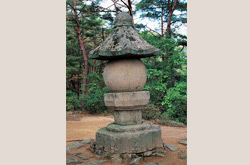
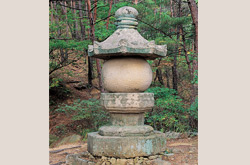
Designated Treasure No. 15, the Stone Lamp of the Four Heavenly Kings was created circa 720 (the 19th regnal year of King Seongdeok of Silla). The epitome of a traditional Korean stone lantern, it takes the form of an octagonal pillar. With a height of 3.9 meters, this tall lantern consists of a pedestal, a lower stylobate, a middle pillar, an upper stylobate, a lamp housing, and a roof stone. The lamp housing, the most important element, is carved with the Four Heavenly Kings on each of the four sides, a feature that gave this artifact its name.

Rock-carved Seated Buddha

Rock-carved Seated Buddha

Designated Treasure No. 216, the Rock-carved Seated Buddha is a Buddha statue carved on the vertical surface of a rock, known as Churaeam Rock, situated near a sarira shrine. Its rounded face, and almost closed eyes, voluminous lips, broad shoulders, noticeably slim waist, and other features make the statue a work of unrealistic abstraction. Lotus buds that serve as the Buddha’s seat surround the figure. On the ground below the feet sits a stone table partially carved with a lotus design.

* Total height: 6.18 m; lotus seat height: 2.84 m; lotus seat width: 2.27 m

Daeungbojeon Hall

Daeungbojeon Hall

Designated Treasure No. 915, Daeungbojeon Hall is a two-story building established by Patriarch Uisin in 553 (the 14th regnal year of King Jinheung of Silla) and later rebuilt by Great Master Byeogam in 1624 (the 2nd regnal year of King Injo of Joseon). This large-scale 20-meter tall building consists of 120 kan (bays) with a floor area of some 561 m2. Inside the hall is the Clay Seated Vairocana Buddha Triad (Treasure No. 1360), the largest of its kind in Korea. The sitting height and waist circumference of the Buddhas are a staggering 5.5 and 3.9 meters, respectively. The central Buddha is Vairocana Buddha, the Dharma body Buddha representing the true essence of all things; the one on the left is Rocana Buddha, the reward body that is to manifest itself from the karma of prolonged cultivation practice in the past; and the one on the right is Shakyamuni Buddha, a temporal Buddha that came to the world to deliver all living beings.

The Buddha triad is the largest array of Buddhas in the country enshrined inside a building. To illustrate the concept of the three bodies of the Buddha, we humans have the mind; virtue, which we gain by acquiring knowledge through learning; and the body. We all embody these disparate aspects. The central Buddha in the hall represents the mind; the one on the left, virtue; and the one on the right, the body. In this regard, the Buddha is one, but represented through the three bodies to help us better understand the aforementioned concept.

Wontongbojeon Hall

Wontongbojeon Hall

Designated Treasure No. 916, Wontongbojeon Hall was built by Patriarch Uisin at the time of Beopjusa Temple’s foundation and later rebuilt by Precepts Master Jinpyo in 776. During the Imjin War, it was destroyed again and later restored by Great Master Byeogam in 1624. Inside the hall sits a gigantic Wooden Seated Avalokitesvara Bodhisattva (Treasure No. 1361) with a benevolent face, whose sitting height and waist circumference are 2.8 and 1.9 meters, respectively. This rare one-story square-shaped hall showcases the subtle yet splendid architectural beauty of the mid-Joseon period, with its column-head bracket system (known as the jusimpo style) and a square roof that features a jar-shaped finial adding to its uniqueness.

Hanging Painting

Hanging Painting

Designated Treasure No. 1259, this ultra-large Buddhist painting, measuring 14.24 meters long and 6.79 meters wide, was created in 1766 (the 42nd regnal year of King Yeongjo of Joseon). The elaborate decoration of five-colored clouds and flowers makes this gigantic painting of Maitreya Buddha even more majestic. The Buddha features a circular halo and body illumination, with the hands holding a branch of a bodhi tree. The painting is exhibited during outdoor Dharma assemblies. According to historical records, 14 monks, including Monk Painter Juhun, participated in its creation.

Stone Standing Bodhisattva

Stone Standing Bodhisattva

Created circa 720 (the 19th regnal year of King Seongdeok, the 33rd king of Silla), this standing statue holds an incense burner on its head. The incense burner is carved with a lotus design on its side. The bodhisattva is wearing an open robe, and its impressive muscles give the entire work a sense of strength. It is said that the statue is a depiction of the Bodhisattva Beautiful offering incense to the Buddha for eons. Designated Treasure No. 1417, the statue is around two meters tall and made of granite.

Iron Pot

Iron Pot

This massive cauldron (Treasure No. 1413), measuring 1.2 meters tall, 2.87 meters in diameter, and 10.8 centimeters in thickness, is believed to have been cast during the reign of King Seongdeok of Silla. It is also said that the cauldron was used to prepare soybean paste soup for 30,000 people and that warrior monks were fed using this cauldron during the Imjin War.

Folding Screen of Sinbeop cheonmundo (Celestial Charts)

Folding Screen of Sinbeop cheonmundo (Celestial Charts)

Designated Treasure No. 848, this folding screen features celestial charts produced by An Guk-bin and five other officials from Gwansanggam (the Bureau of Astronomy), based on the star table (as of 1723) created by Koegler, a missionary who served as Director of the Beijing Observatory. The charts feature stars from the southern sky invisible from Hanyang (present-day Seoul). This eight-panel folding screen is a staggering 4.51 meters long, with each panel measuring 183.5 centimeters tall and 56 centimeters wide.

The first panel features the title “Regarding New Celestial Charts” (新法天文圖說) and astronomical knowledge of the time conveyed through 510 Chinese characters. To the left of this writing is an illustration of (from top to bottom) the Sun, the Moon, and five planets (i.e., Saturn, Jupiter, Mars, Venus, and Mercury) observed through the telescope, each depicted in a different size and color. In the combined space of panels 2-4, three concentric circles are present, each with a diameter of 165, 162.7, and 161 centimeters, respectively. The space between the middle and inner circles is marked with 180 jo and 180 gan, creating 360 divisions in all directions. As such, the gap between a jo and a gan amounts to a single degree.

Similarly, the combined space of panels 5-7 resembles that of panels 2-4 in style. The former panels depict the stars of the southern sky centered around the south pole of the ecliptic. As in panels 2-4, these panels show the equator. However, unlike in the northern sky, the equator here is in the shape of an arc that connects the left and right mid-points of the great circle with points measured at 23.5° from the bottom of the circle. As such, unlike in the case of the northern sky, the left mid-point of the southern sky denotes the vernal equinox point and the right mid-point the autumn equinox point. Finally, the eighth panel lists the positions and names of six officials from Gwansanggam (the Bureau of Astronomy) who participated in the production of these charts.

Clay Seated Vairocana Buddha Triad

Clay Seated Vairocana Buddha Triad

Designated Treasure No.1360 on February 3, 2003, the triad consists of Vairocana Buddha, the main Buddha of worship; Rocana Buddha to its left; and Shakyamuni Buddha to its right, with respective heights of 509, 492, and 471 centimeters. These statues are made of clay and in relatively good condition. They were created in 1626 (the 4th regnal year of King Injo) and gilded with gold later in 1747 (the 23rd regnal year of King Yeongjo).

The square face and elongated earlobes of the Vairocana Buddha, coupled with its robust angular body and knees, convey a sense of heftiness. The head is adorned with two jewels in the top and frontal regions, and the hands are positioned in a mudra symbolizing the wisdom of Vairocana. The Dharma robe is worn in a manner that covers both shoulders, with both the right and left sides of the robe draping all the way down to the wrists in symmetry. The Rocana Buddha is similar in appearance to the Vairocana Buddha, except that it features a mudra that symbolizes the middle of the lowest class. The head of this Buddha is also decorated with a large jewel at the center of the frontal region. As for the Shakyamuni Buddha, its body shape, facial appearance, and style are almost the same as those of the other two Buddhas, except for its typical Bhumisparsha Mudra where the tip of its right hand, resting on the lap, points toward the ground. The Rocana Buddha and the Shakyamuni Buddha are wearing robes in the same style despite their different natures and mudras. The three Buddha have relatively young faces compared to their massive physique, and their robes feature thick wrinkles.

Wooden Seated Avalokitesvara Bodhisattva

Wooden Seated Avalokitesvara Bodhisattva

Designated Treasure No. 1361 on February 3, 2003, this statue measures 2.35 meters high and 1.47 meters wide. Created in 1655 (the 6th regnal year of King Hyojong), it is enshrined within Wontongbojeon Hall (Treasure No. 916) of Beopjusa Temple.

The bodhisattva is seated in the full lotus posture. The head enshrines the Buddha incarnate in the middle and is lavishly decorated with flames. Similarly, its abdomen is covered with a plastron-like curved plate featuring a flower design. Such adornments make the overall statue highly ornate. The bodhisattva is also flanked on each side by figurines depicting the Dragon King of the Southern Seas and young Sudhana. In particular, the painting of the Avalokitesvara Bodhisattva behind the statue renders the whole scene even more striking. Furthermore, the square face and downcast eyes give the bodhisattva a sense of solemnity. The hands are also positioned in a mudra that represents the middle of the lowest class, with the right hand raised to the upper waist and the left hand to the abdomen while the thumb and middle finger of each hand are touching at the tips. The depiction of this mudra is realistic and utilizes aesthetic curves, giving the hands a sense of vividness that evokes the form of real hands. Unlike the thin and delicate hands featured in typical bodhisattvas, the hands and fingers of this statue are large and expansive in gesture. The celestial garment, which covers both shoulders, drapes naturally along the contours of the body, presenting a voluminous sense of aesthetic curvaceousness.

Stupa of Buddhist Monk Suam at Bokcheonam Hermitage

Stupa of Buddhist Monk Suam at Bokcheonam Hermitage

Created in 1480 (the 10th regnal year of King Seongjong), this stupa belongs to Great Master Sinmi (also known as Venerable Hyegak; 1405?-1480) from the early Joseon period. He was born as the first son of Kim Hun, who was posthumously appointed Chief State Councilor during the reign of King Seongjong. His secular name was Suseong, and he was also referred to as Suam. Given that his younger brother was Kim Su-on (1410-1481), he was most likely born around 1405. Before entering monastic life, he studied at Seonggyungwan National Academy. Around 1446 (the 28th regnal year of King Sejong), he met King Sejong and came into favor with many grand princes. At the time, despite strong opposition from Confucian students, Master Sinmi became Great Master of the Seon and Gyo (doctrinal) schools, overseeing a national ceremony known as Suryukjae (Water and Land Ceremony). During the reign of King Munjong, he was elevated to the position of leading both the Seon and Gyo schools of Buddhism. During the reign of King Sejo, he earned a great deal of respect from the king for leading a sutra publication project, and was referred to as one of the “Three Preceptors” along with his two disciples Hakyeol and Hakjo. The stupas of him and Hakjo are enshrined at Bokcheonam Hermitage of Songnisan Mountain. In 2004, his stupa was upgraded in stature from Chungcheongbuk-do Tangible Cultural Heritage to Treasure No. 1416.

Stupa of Buddhist Monk Hakjo at Bokcheonam Hermitage

Stupa of Buddhist Monk Hakjo at Bokcheonam Hermitage

Created in 1514 (the 10th regnal year of King Jungjong), this stupa belongs to Great Master Hakjo (Deunggok) who was active during the reign of King Yeonsangun. It is located behind the stupa of Great Master Sinmi, his preceptor. In 1464 (the 10th regnal year of King Sejo), the two masters held a great Dharma assembly at Bokcheonam Hermitage of Songnisan Mountain, in which the king participated. In 1467 (the 13th regnal year of King Sejo), Hakjo rebuilt Yujeomsa Temple of Geumgangsan Mountain and then stayed at Bongseonsa Temple. Later, in 1488 (the 19th regnal year of King Seongjong), while staying at Jikjisa Temple of Gimcheon, he supervised the rebuilding of Haeinsa Temple as well as Jingwansa, Daejisa, and Naksansa Temples, following the order of Queen Dowager Insu. In 1500 (the 6th regnal year of King Yeonsangun), at the command of Queen Sin, he also published a printed copy of the Tripitaka Koreana, using its wooden printing blocks housed at Haeinsa Temple, and wrote its epilogue. In this regard, he was an eminent monk who was active during the early Joseon period. In 1514 (the 9th regnal year of King Jungjong), his stupas were built at Bokcheonam Hermitage of Songnisan Mountain and Jikjisa Temple of Gimcheon. In 2004, the stupa at Bokcheonam Hermitage was upgraded in stature from Chungcheongbuk-do Tangible Cultural Heritage No. 13 to Treasure No. 1418.

Privacy Policy

All personal information handled by Beopjusa Temple, the 5th District Head Temple of the Jogye Order of Korean Buddhism (hereinafter “Beopjusa”), is collected, retained and processed in accordance with relevant laws or with the consent of the data subject.

1. Purpose of Processing Personal Information

In providing the services of the Beopjusa website, we process personal information for the purposes of searching and using temple administration materials, handling inquiries and applications, using the boards, and handling civil petitions.

2. Security of Personal Information

Beopjusa manages the personal information it processes securely and destroys personal information without delay once the purpose of processing has been achieved.

3. Use and Provision of Personal Information

Beopjusa does not use personal information or provide it to third parties for purposes other than those announced on the website or stated in the terms of use. However, personal information may be used or provided in the following cases:

  • When separate consent has been obtained from the data subject
  • When legal action is to be taken against wrongful conduct, or when requested by a judicial authority
  • When necessary for statistics or academic research, provided in a form that does not identify a specific individual

4. Restriction of Access to Personal Information

Access to personal information is controlled and recorded by granting, changing and revoking access rights to the personal information processing system, to prevent exposure of information.

5. Correction of Personal Information and Rights of Users

Users may request to view their personal information and to correct errors, and the website administrator will promptly process such requests after verifying the user’s identity.

6. Person in Charge of Personal Information

Lee Chae-young, General Affairs Manager, Beopjusa Temple Administrative Office · 043-544-3616

7. Changes to the Privacy Policy

Beopjusa will announce any changes to this privacy policy on the website.

This privacy policy takes effect on December 1, 2026.

8. Remedies for Infringement of Rights

Data subjects may report or seek counseling from the following organizations to obtain remedies for infringement of personal information:

This English translation is provided for convenience. In case of any discrepancy, the Korean version prevails.

No Unauthorized Email Collection

We refuse the unauthorized collection of email addresses posted on this website by email-harvesting programs or any other technical means. Please note that violations are subject to criminal penalties under the Act on Promotion of Information and Communications Network Utilization and Information Protection (the “Network Act”).

Article 50 (Restrictions on Transmission of Advertising Information for Profit)

  1. ① Any person who intends to transmit advertising information for profit by electronic transmission media shall obtain the explicit prior consent of the recipient. However, prior consent is not required in any of the following cases: <Amended Mar. 22, 2016; Jun. 9, 2020>
    • 1.1. Where a person who has directly collected the recipient’s contact information through a transaction of goods, etc. intends to transmit, within the period prescribed by Presidential Decree, advertising information for profit about goods, etc. of the same kind as those he or she handles and has traded with the recipient
    • 1.2. Where a telemarketer under the Door-to-Door Sales Act informs the recipient by voice of the source from which the personal information was collected and makes a telephone solicitation
  2. ② Notwithstanding paragraph (1), any person who intends to transmit advertising information for profit by electronic transmission media shall not transmit it if the recipient has expressed refusal to receive it or has withdrawn prior consent.
  3. ③ Notwithstanding paragraph (1), any person who intends to transmit advertising information for profit by electronic transmission media between 9 p.m. and 8 a.m. of the following day shall obtain separate prior consent from the recipient, except for media prescribed by Presidential Decree.
  4. ④ Any person who transmits advertising information for profit by electronic transmission media shall specifically state the following in the advertising information, as prescribed by Presidential Decree:
    • 4.1. The name and contact information of the sender
    • 4.2. Measures and methods by which the recipient can easily express refusal to receive or withdraw consent
  5. ⑤ Any person who transmits advertising information for profit by electronic transmission media shall not take any of the following measures:
    • 5.1. Measures to evade or obstruct a recipient’s refusal to receive or withdrawal of consent
    • 5.2. Measures to automatically generate recipients’ contact information, such as telephone numbers or email addresses, by combining numbers, symbols or letters
    • 5.3. Measures to automatically register telephone numbers or email addresses for the purpose of transmitting advertising information for profit
    • 5.4. Any measures to conceal the identity of the sender or the source of the advertisement
    • 5.5. Any measures to induce replies by deceiving recipients for the purpose of transmitting advertising information for profit
  6. ⑥ Any person who transmits advertising information for profit by electronic transmission media shall take necessary measures, as prescribed by Presidential Decree, so that recipients do not bear monetary costs such as telephone charges when refusing to receive or withdrawing consent.
  7. ⑦ When a recipient expresses prior consent under paragraph (1), or refusal or withdrawal of consent under paragraph (2), the sender shall notify the recipient of the result of processing, as prescribed by Presidential Decree.
  8. ⑧ Any person who has obtained consent under paragraph (1) or (3) shall periodically confirm whether the recipient still consents, as prescribed by Presidential Decree.

[Wholly amended May 28, 2014]

Article 74 (Penalty Provisions)

  1. ① Any of the following persons shall be punished by imprisonment with labor for not more than one year or by a fine not exceeding 10 million won: <Amended Feb. 17, 2012; May 28, 2014>
    • 1. A person who, in violation of Article 8 (4), labels, sells or displays for sale products bearing a similar mark
    • 2. A person who, in violation of Article 44-7 (1) 1, distributes, sells, rents or openly displays obscene codes, words, sounds, images or videos
    • 3. A person who, in violation of Article 44-7 (1) 3, repeatedly sends codes, words, sounds, images or videos that arouse fear or anxiety to another person
    • 4. A person who takes measures in violation of Article 50 (5)
    • 5. Deleted <May 28, 2014>
    • 6. A person who transmits advertising information in violation of Article 50-8
    • 7. A person who fails to register changes in registered matters or to report the transfer, acquisition, merger or inheritance of a business in violation of Article 53 (4)
  2. ② The crime under paragraph (1) 3 shall not be prosecuted against the explicit will of the victim.

[Wholly amended Jun. 13, 2008]