Temple Museum ➚
Beopjusa Temple MuseumTemple Museum ➚TemplestayTemplestay ➚

Heritage & Treasures

Provincial Tangible Cultural Heritage

Provincial Tangible Cultural Heritage refers to cultural properties that have not been designated at the national level, but are instead designated by provincial governors (or city mayors) following deliberation by the provincial cultural heritage committee. — 22 items designated as Chungcheongbuk-do Tangible Cultural Heritage

Royal Placenta Chamber of King Sunjo

Chungcheongbuk-do Tangible Cultural Heritage No.11.

Located on the peak of Taebongsan Mountain, opposite Bokcheonam Hermitage, this placenta chamber (taesil) enshrines the placenta of King Sunjo, the 23rd monarch of the Joseon Dynasty. Influenced by the Taesjanggyeong(Sutra of Placenta Burial)—which believed that a person's fortune and destiny were connected to their placenta—the Joseon court practiced burying placentas in auspicious sites. Placenta chambers were initially established as birth rituals for royal infants and were later reconstructed and enhanced with stone structures if the child ascended to the throne.

An octagonal circular-hall style structure featuring a square foundation stone at the base, a spherical middle stone, and an octagonal roof stone topped with a jewel (boju) carving, surrounded by base stones and protective stone railings.

World-Honored One Relic Pagoda of Beopjusa Temple

World-Honored One Relic Pagoda of Beopjusa Temple

Chungcheongbuk-do Tangible Cultural Heritage No.16 (Height: 3.5m).

According to historical records, in 1362 (the 11th year of King Gongmin's reign), following his victory over the Red Turbans, King Gongmin visited Beopjusa Temple and transferred one of Sakyamuni Buddha's relics previously enshrined at Tongdosa Temple to be enshrined here.

Designed in the traditional octagonal circular-hall (palgak wondanghyeong) style. It consists of a base structure, a pagoda body, a roof stone (okgaeseok), and a decorative pinnacle (sangnyun) at the top. The foundation features an octagonal base placed upon a flat square ground stone.

Four Heavenly Kings Gate

Chungcheongbuk-do Tangible Cultural Heritage No.46 (Designated December 6,1977).

Situated between the Geumgangmun Gate and Palsangjeon Hall (National Treasure No.55) of Beopjusa Temple, this sacred gateway is a multi-bracket (daposik) building with a gable roof (matbae jibeung), measuring 5 bays wide and 2 deep. The central bay serves as a walkway, while the two bays on either side house four statues of the Heavenly Kings (Sacheonwang), each standing 5.7 meters tall and measuring 1.8 meters in circumference. Evaluated as masterpieces of their kind in Korea, these statues are owned and managed by Beopjusa Temple.

The Four Heavenly Kings

  • Dhritarashtra (Eastern Heavenly King) : Guards the eastern continent of Mt. Sumeru, holding a pipa (lute).
  • Virupaksha (Western Heavenly King) : Guards the western continent, holding a dragon and a wish-granting jewel.
  • Virudhaka (Southern Heavenly King) : Guards the southern continent, holding a sword.
  • Vaisravana (Northern Heavenly King) : Guards the northern continent, holding a sacred pagoda.

Stone Basin of Beopjusa Temple

Chungcheongbuk-do Tangible Cultural Heritage No.70 (Designated November 13,1980).

A large stone water basin owned and managed by Beopjusa Temple. Created in 720 (the 19th year of King Seongdeok's reign), it is estimated to have been used when Beopjusa flourished with a large community of over 3,000 resident monks. Measuring 130 cm in height,446 cm in length,240 cm in width, and 21 cm in wall thickness, this massive granite basin has a capacity equivalent to 80 bags of rice.

The four vertical walls are plain and undecorated inside and out, with the upper edges neatly angled. The wall thicknesses vary slightly (23 cm on the long sides,34 cm on the short sides) to maintain proportional balance. A drainage hole 11 cm in diameter at the bottom of the southern wall confirms its practical use. It remains largely intact in its original form, save for minor chipping along one corner.

Monument for State Preceptor Byeogam

Chungcheongbuk-do Tangible Cultural Heritage No.71 (Designated November 13,1980).

Located on a rock in front of Sujeonggyo Bridge at the entrance of Beopjusa Temple, this stone stele honors the mid-Joseon monk Gakseong (Byeogam). Erected in 1664 (the 5th year of King Hyeonjong's reign), it stands 210 cm tall,110 cm wide, and 35 cm thick, topped with a hip-and-gable roof style capstone. The epitaph was composed by Jeong Du-gyeong, written in calligraphy by Lee Woo, and engraved by Lee Jeong.

Monument for State Preceptor Jajeong

Chungcheongbuk-do Tangible Cultural Heritage No.79.

Erected in 1342 (the 3rd year of King Chungsuk/Chunghye's reign of Goryeo), this stele records the life and achievements of State Preceptor Jajeong, who resided at Beopjusa in 1270.Preceptor Jajeong stayed at numerous temples lecturing on the Vijnaptimatratasiddhi shastra(Treatise on Awakening to Mahayana Faith / Yogacara teachings) and authored 92 volumes of scriptural commentaries. He served as the head abbot of Beopjusa in his later years and entered parinirvana at the age of 88.(Dimensions: 2.13m high,1.07m wide).

Monument on the Facts of Mt. Songnisan

Chungcheongbuk-do Tangible Cultural Heritage No.167.

Housed within a pavilion near Sujeonggyo Bridge close to the entrance of Songnisan National Park and Beopjusa Temple. Measuring 1.63m in height and 0.65m in width, it was erected in 1666 (the 7th year of King Hyeonjong's reign). The text was composed by Song Si-yeol and inscribed by the master calligrapher Song Jun-gil. The inscription records the history of the Turtle Rock located atop Sujeongbong Peak of Mt. Songnisan and calls for the eradication of superstition.

Twin Pagodas in Geumganggol Valley

Chungcheongbuk-do Tangible Cultural Heritage No.200 (Designated September 15,2000).

During the Three Kingdoms period when temples were primarily built on flat ground, single-pagoda layouts placed in front of the main Buddha hall (goldang) were common. By the early Unified Silla period, twin-pagoda layouts—such as those at Bulguksa, Gameunsa, and Goseonsa temples—became popular. This represents the "two pagodas, one main hall" architectural format, famously exemplified by the Dabotag and Seokgatap pagodas at Bulguksa Temple.

Stone Storage Vessel / Stone Jar

Chungcheongbuk-do Tangible Cultural Heritage No.204 (Designated December 22,2000).

Originally located near the temple kitchen, this jar-shaped stone vessel is now buried approximately 40 meters to the left of Chongji Seonwon Hall within the Beopjusa grounds. Although its exact production date is unknown, tradition holds that it was used as a kimchi storage vat for the 3,000 monks who resided at Mt. Songnisan.

Neunginjeon Hall of Beopjusa Temple

Chungcheongbuk-do Tangible Cultural Heritage No.232 (Designated January 9,2004).

Located in front of the World-Honored One Relic Pagoda at Beopjusa Temple. Inside are enshrined the main Buddha statue of Sakyamuni, along with statues of the 16 Arhats and a Tathagata statue of unknown date, accompanied by a guardian painting (sinjungtaeng) created in 1992.Along with Palsangjeon Hall (National Treasure No.55), Daeungbojeon Hall (Treasure No.915), Wontongbojeon Hall (Treasure No.916), and the Four Heavenly Kings Gate, Neunginjeon is a precious surviving Joseon-era building of high preservation value.

Former Ancestral Shrine for Royal Consort Seonhuigung at Beopjusa

Chungcheongbuk-do Tangible Cultural Heritage (Associated with Joseon royal ancestral rituals).

A small building situated east (to the right) of Daeungbojeon Hall. It was originally built around 1765 to enshrine the ancestral spirit tablet and hold memorial rites for Royal Consort Yeongbin Lee, a consort of King Yeongjo (the 21st Joseon king) and mother of Crown Prince Sado. After the spirit tablet was relocated elsewhere, the building served as a Josagak(Patriarch Shrine) housing portraits of eminent past masters of Beopjusa. Since a separate Portrait Hall (Jinyeonggak) was established west of Daeungbojeon in 1990, the building has remained vacant and is often referred to by the temple as the "Former Patriarch Shrine.“

Gunhyeondang Hall of Beopjusa Temple

Chungcheongbuk-do Tangible Cultural Heritage No.234 (Designated January 9,2004).

Located to the right of Palsangjeon Hall (National Treasure No.55), Gunhyeondang serves as the main meditation hall (seondang) of Beopjusa. Originally built in 1632 (the 10th year of King Injo's reign) during the Joseon Dynasty, it was thoroughly renovated and rebuilt in 1852 (the 3rd year of King Cheoljong's reign), as verified by the ridge-beam inscription (sangyangmun) bearing the cyclical year Imsa-nyeon. The inscription also preserves the roster of resident monks and carpenters who constructed the hall, making it an exceptionally valuable historical structure.

Bronze Bell of Beopjusa Temple Dating to the 9th Year of Jiaqing

Chungcheongbuk-do Tangible Cultural Heritage No.236 (Designated July 9,2004).

A Joseon Dynasty bronze bell cast in July 1804 (the 4th year of King Sunjo's reign, corresponding to the 9th year of the Jiaqing era) using 4,000 catties of copper. It was funded by one primary donor and fifteen general donors. While its overall scale is large, the surface reliefs are shallow and casting techniques are relatively modest. Nevertheless, it holds significant preservation value due to its clear dedicatory inscription—documenting the makers, production year, and temple name—and its representative Joseon bell style.

Small Bronze Bell from Mungsajaam Hermitage, Boeun

Chungcheongbuk-do Tangible Cultural Heritage No.237 (Designated July 9,2004).

Also known as the Chongjeong-Ninth-Year Bronze Bell of Beopjusa. Originally housed at Mungsajaam Hermitage (reconstructed during the Injo period as a sub-temple of Beopjusa), it was later relocated and is currently kept in the Beopjusa artifact repository. Despite its compact size, it is evaluated as an aesthetic and academic masterpiece blending late Goryeo and Joseon bell styles, featuring exquisite casting and detailed inscriptions recording its origin and donors.

Folding Screen of Royal Calligraphy by King Seonjo at Beopjusa

Folding Screen of Royal Calligraphy by King Seonjo at Beopjusa

Chungcheongbuk-do Tangible Cultural Heritage No.238 (Designated July 9,2004).

An 8-panel folding screen featuring cursive-script (choseoche/grass script) calligraphy by King Seonjo of the Joseon Dynasty. Tradition holds it was bestowed upon Beopjusa in 1758 (the 34th year of King Yeongjo's reign) along with other treasures such as the New Astronomical Chart Folding Screen. Each panel measures 67 cm wide by 190 cm tall. Written in fluid cursive script by King Seonjo around 1631, it serves as an important resource for researching Joseon woodblock printing culture and calligraphy history.

Folding Screen of the

Folding Screen of the "Wuyil" Chapter from the Book of Documents at Beopjusa

Chungcheongbuk-do Tangible Cultural Heritage No.239 (Designated July 9,2004).

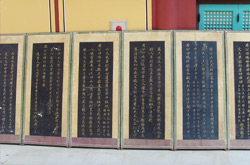
A 10-panel folding screen inscribed with the "Wuyil" (Against Luxurious Ease) chapter from the Book of Documents(Shujing). Each panel measures 73.5 cm wide by 170 cm tall. A unique feature of this screen is that the text was written entirely using gold powder (geumpun) rather than black ink. Estimated to have been created prior to 1758, it is valued as a precious resource for the study of Joseon-era calligraphy.

Privacy Policy

All personal information handled by Beopjusa Temple, the 5th District Head Temple of the Jogye Order of Korean Buddhism (hereinafter “Beopjusa”), is collected, retained and processed in accordance with relevant laws or with the consent of the data subject.

1. Purpose of Processing Personal Information

In providing the services of the Beopjusa website, we process personal information for the purposes of searching and using temple administration materials, handling inquiries and applications, using the boards, and handling civil petitions.

2. Security of Personal Information

Beopjusa manages the personal information it processes securely and destroys personal information without delay once the purpose of processing has been achieved.

3. Use and Provision of Personal Information

Beopjusa does not use personal information or provide it to third parties for purposes other than those announced on the website or stated in the terms of use. However, personal information may be used or provided in the following cases:

  • When separate consent has been obtained from the data subject
  • When legal action is to be taken against wrongful conduct, or when requested by a judicial authority
  • When necessary for statistics or academic research, provided in a form that does not identify a specific individual

4. Restriction of Access to Personal Information

Access to personal information is controlled and recorded by granting, changing and revoking access rights to the personal information processing system, to prevent exposure of information.

5. Correction of Personal Information and Rights of Users

Users may request to view their personal information and to correct errors, and the website administrator will promptly process such requests after verifying the user’s identity.

6. Person in Charge of Personal Information

Lee Chae-young, General Affairs Manager, Beopjusa Temple Administrative Office · 043-544-3616

7. Changes to the Privacy Policy

Beopjusa will announce any changes to this privacy policy on the website.

This privacy policy takes effect on December 1, 2026.

8. Remedies for Infringement of Rights

Data subjects may report or seek counseling from the following organizations to obtain remedies for infringement of personal information:

This English translation is provided for convenience. In case of any discrepancy, the Korean version prevails.

No Unauthorized Email Collection

We refuse the unauthorized collection of email addresses posted on this website by email-harvesting programs or any other technical means. Please note that violations are subject to criminal penalties under the Act on Promotion of Information and Communications Network Utilization and Information Protection (the “Network Act”).

Article 50 (Restrictions on Transmission of Advertising Information for Profit)

  1. ① Any person who intends to transmit advertising information for profit by electronic transmission media shall obtain the explicit prior consent of the recipient. However, prior consent is not required in any of the following cases: <Amended Mar. 22, 2016; Jun. 9, 2020>
    • 1.1. Where a person who has directly collected the recipient’s contact information through a transaction of goods, etc. intends to transmit, within the period prescribed by Presidential Decree, advertising information for profit about goods, etc. of the same kind as those he or she handles and has traded with the recipient
    • 1.2. Where a telemarketer under the Door-to-Door Sales Act informs the recipient by voice of the source from which the personal information was collected and makes a telephone solicitation
  2. ② Notwithstanding paragraph (1), any person who intends to transmit advertising information for profit by electronic transmission media shall not transmit it if the recipient has expressed refusal to receive it or has withdrawn prior consent.
  3. ③ Notwithstanding paragraph (1), any person who intends to transmit advertising information for profit by electronic transmission media between 9 p.m. and 8 a.m. of the following day shall obtain separate prior consent from the recipient, except for media prescribed by Presidential Decree.
  4. ④ Any person who transmits advertising information for profit by electronic transmission media shall specifically state the following in the advertising information, as prescribed by Presidential Decree:
    • 4.1. The name and contact information of the sender
    • 4.2. Measures and methods by which the recipient can easily express refusal to receive or withdraw consent
  5. ⑤ Any person who transmits advertising information for profit by electronic transmission media shall not take any of the following measures:
    • 5.1. Measures to evade or obstruct a recipient’s refusal to receive or withdrawal of consent
    • 5.2. Measures to automatically generate recipients’ contact information, such as telephone numbers or email addresses, by combining numbers, symbols or letters
    • 5.3. Measures to automatically register telephone numbers or email addresses for the purpose of transmitting advertising information for profit
    • 5.4. Any measures to conceal the identity of the sender or the source of the advertisement
    • 5.5. Any measures to induce replies by deceiving recipients for the purpose of transmitting advertising information for profit
  6. ⑥ Any person who transmits advertising information for profit by electronic transmission media shall take necessary measures, as prescribed by Presidential Decree, so that recipients do not bear monetary costs such as telephone charges when refusing to receive or withdrawing consent.
  7. ⑦ When a recipient expresses prior consent under paragraph (1), or refusal or withdrawal of consent under paragraph (2), the sender shall notify the recipient of the result of processing, as prescribed by Presidential Decree.
  8. ⑧ Any person who has obtained consent under paragraph (1) or (3) shall periodically confirm whether the recipient still consents, as prescribed by Presidential Decree.

[Wholly amended May 28, 2014]

Article 74 (Penalty Provisions)

  1. ① Any of the following persons shall be punished by imprisonment with labor for not more than one year or by a fine not exceeding 10 million won: <Amended Feb. 17, 2012; May 28, 2014>
    • 1. A person who, in violation of Article 8 (4), labels, sells or displays for sale products bearing a similar mark
    • 2. A person who, in violation of Article 44-7 (1) 1, distributes, sells, rents or openly displays obscene codes, words, sounds, images or videos
    • 3. A person who, in violation of Article 44-7 (1) 3, repeatedly sends codes, words, sounds, images or videos that arouse fear or anxiety to another person
    • 4. A person who takes measures in violation of Article 50 (5)
    • 5. Deleted <May 28, 2014>
    • 6. A person who transmits advertising information in violation of Article 50-8
    • 7. A person who fails to register changes in registered matters or to report the transfer, acquisition, merger or inheritance of a business in violation of Article 53 (4)
  2. ② The crime under paragraph (1) 3 shall not be prosecuted against the explicit will of the victim.

[Wholly amended Jun. 13, 2008]